🇺🇸 CIA
Moscow Public Opinion and Soviet Elections
Summary
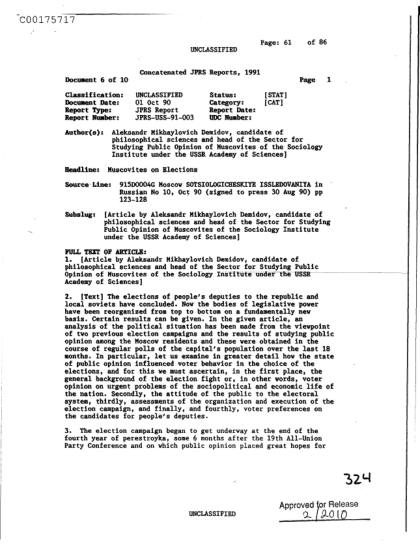
In the 1990s, Moscow experienced profound political transformations with the collapse of the Soviet system. A sociological study reveals how Muscovites perceived and participated in the elections of representatives. The perestroika generated expectations but also disappointments. The population showed skepticism toward reforms and the Communist Party, whose authority was declining. In the 1989 elections, voters valued honesty and social justice in candidates, preferring intellectuals and workers. However, campaign organization was flawed, with unequal information dissemination and undemocratic methods. The electoral experience evolved by 1990, with a more critical and demanding electorate, although enthusiasm waned. Results reflected growing polarization and a desire for radical change. Public opinion showed increasing political awareness, though authoritarian tendencies and a certain mystical inclination persisted. In summary, the study captures a crucial transitional moment in Moscow's history, where society redefined itself under new democratic rules.