🇺🇸 CIA
Soviet Submarine U-137 and Self-Destruction Orders
Summary
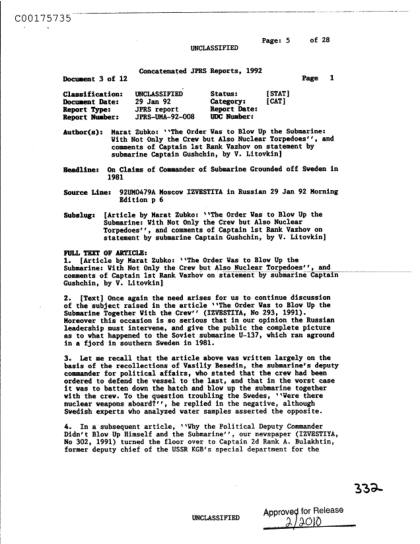
In 1981, the Soviet submarine U-137 ran aground in a Swedish fjord. According to testimonies, it received orders to self-destruct along with its crew and nuclear torpedoes. This revelation sparked controversy, especially since Swedish experts found evidence of nuclear weapons onboard. Vasiliy Besedin, a submarine officer, denied the presence of weapons, but other accounts contradict his version. A former commander, Anatoliy Gushchin, claimed that the submarine did carry nuclear weapons and that there was an explicit order to destroy it if necessary. This raises questions about nuclear safety and military decisions during the Cold War.
The situation became even more complicated when a Russian officer, Vladimir Vazhov, questioned the accuracy of Gushchin's claims. According to Vazhov, it was technically impossible to destroy the submarine or detonate a torpedo inside its tube. Additionally, the safety mechanisms of nuclear weapons prevented their activation without specific codes. Despite this, the story of the U-137 remains only partially resolved, with questions about military orders, nuclear security, and possible violations of Swedish waters. Transparency about these events remains key to understanding the past and preventing future risks.