🇺🇸 CIA
Soviets and Reagan 1980-1984
Summary
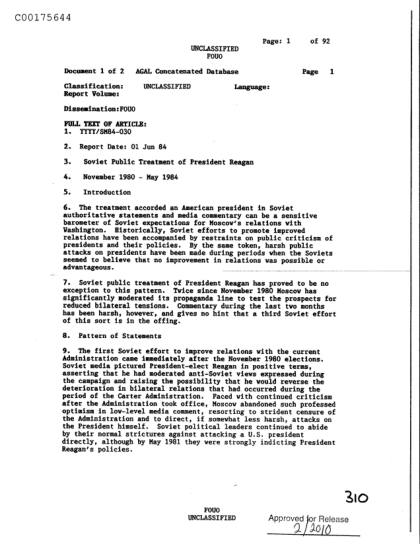
This CIA document analyzes how the Soviet Union publicly addressed U.S. President Ronald Reagan from his election in 1980 to mid-1984. A clear pattern emerges: when Moscow sought to improve bilateral relations, it softened its public criticism of Reagan, but when tensions escalated—especially over issues like nuclear arms or diplomatic incidents—Soviet propaganda became harsher. In the early months of Reagan’s administration, Soviet media cautiously expressed hope that the new government might reverse the deteriorating relationship with Washington, but this optimism faded quickly as U.S. policies continued to be seen as hostile.
The text details how Soviet official statements—both from leaders and media commentators—reflected shifting perceptions of Reagan’s administration. Top Soviet leaders like Brezhnev and later Andropov avoided directly attacking Reagan, instead criticizing "ruling circles" or "Washington" in general. However, mid-level officials and media outlets did not hesitate to launch sharp criticisms. The document also notes that after the Soviet Union's downing of a South Korean airliner, Soviet rhetoric became particularly harsh, accusing the U.S. of aggression and manipulation. This analysis serves as a baseline for understanding how Soviet propaganda functioned as a tool to gauge and respond to U.S. foreign policy.