🇺🇸 CIA
Soviets and Reagan 1980-1984
Summary
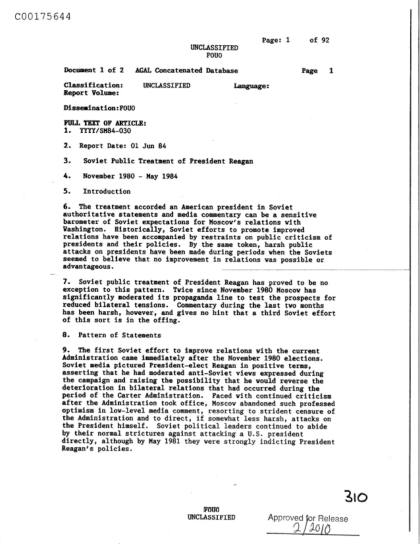
This CIA document analyzes how the Soviet Union publicly addressed relations with U.S. President Ronald Reagan between 1980 and 1984. A clear pattern emerges: when Moscow sought to improve bilateral ties, public criticism of Reagan decreased, but when tensions rose, the rhetoric became harsher. In the early months of Reagan's presidency, Soviet media showed some optimism, suggesting he might reverse the deteriorating relations inherited from the Carter administration. However, as U.S. policies remained firm, Soviet commentary became increasingly aggressive, especially after incidents like the downing of a South Korean airliner.
The text also outlines how criticism was distributed across three levels: Soviet leaders avoided direct attacks on Reagan, instead targeting "Washington" or "ruling circles," while mid-level officials and traditional media used more explicit language. On several occasions, such as after Brezhnev's death or Andropov's rise to power, there were brief attempts to moderate the tone, but these were short-lived. The document concludes that Soviet propaganda served as a sensitive barometer of U.S.-Soviet tensions, reflecting both hope and deep hostility during the Cold War era.