🇺🇸 CIA
A Russian Flying Saucer in Saratov
Summary
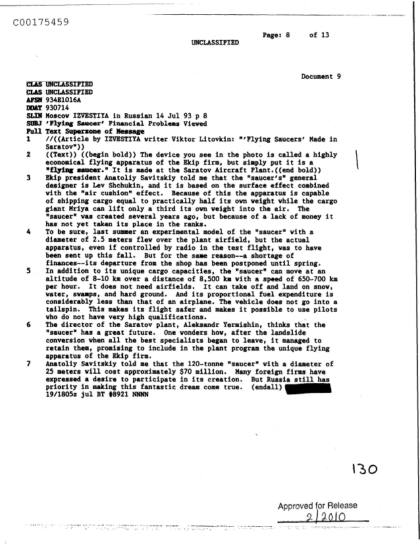
In 1993, a Russian newspaper published an article about an unconventional aerial device developed at the Saratov Aircraft Plant. This craft, called a "flying saucer," was a transport vehicle capable of carrying cargo equal to half its own weight—an unusual feat for an airborne vehicle. Its design combined the surface effect with an air cushion, allowing it to take off and land on snow, water, or swamps. Despite its promising technology, the project faced financial issues that delayed production.
The director of the Ekip firm, Anatoliy Savitskiy, explained that the craft had an estimated cost of $70 million, and many foreign companies had shown interest in its development. Although a 2.5-meter prototype had already performed test flights, the final 25-meter model would not leave the workshop until the following year. The Saratov plant hoped this innovative project would help retain its best engineers during a tough time for the Russian aerospace industry.